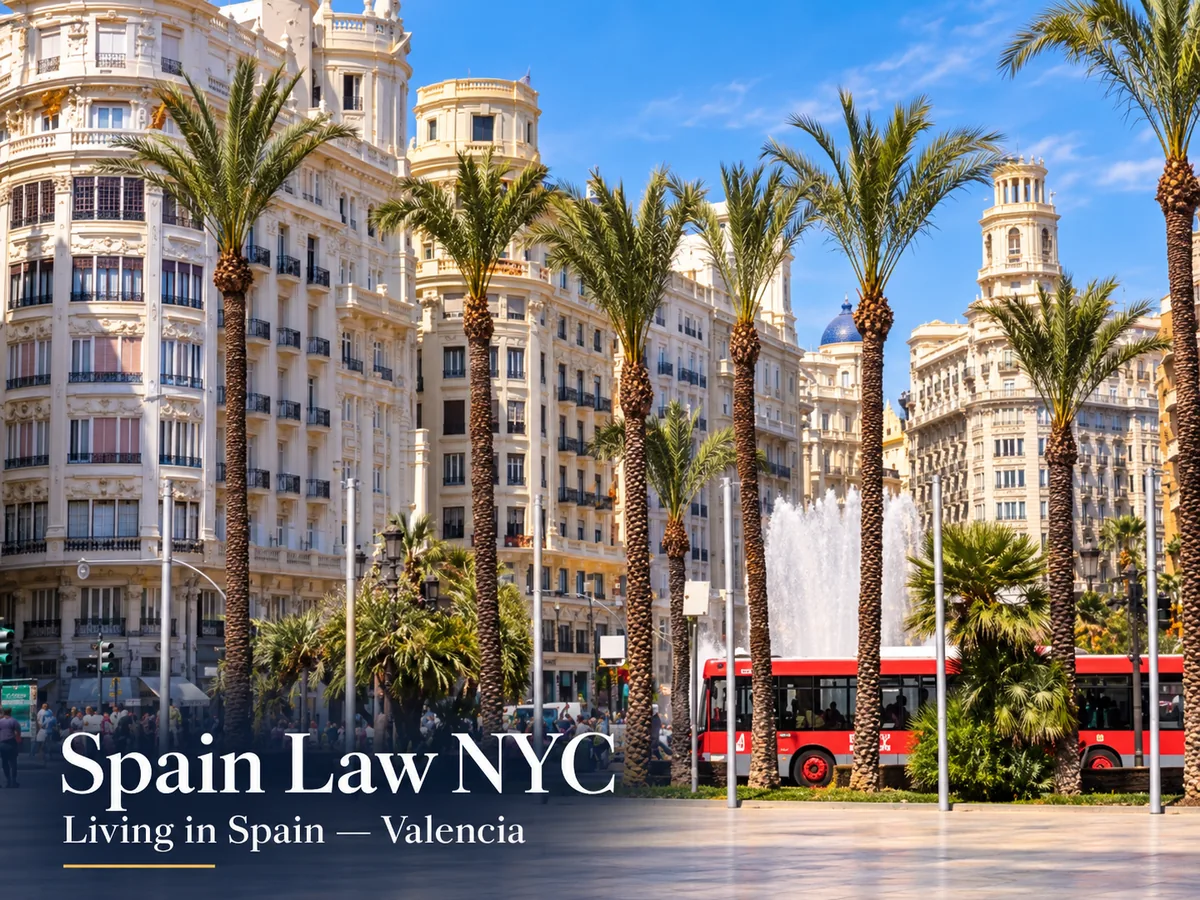
Panoramic sunset view across central Valencia with Spain Law NYC Living in Spain branding.

Living in Spain · Valencia · reviewed October 4, 2026

Living in Valencia as an American: what daily life is really like in 2026

Valencia offers a smaller, flatter and generally less intense Mediterranean-city routine than Madrid or Barcelona, with urban beaches, strong public transport, major universities and a growing international/technology community. Its strongest trade-offs are housing pressure, humid summer heat, tourism in selected districts and fewer long-haul air links than Spain's two largest cities.

Answer first

What is it actually like to live in Valencia as an American?

Valencia is a strong fit for Americans who want Mediterranean outdoor life without giving up a real urban transport network, universities, hospitals, culture and mainland rail. Daily life can be car-light, the beach is part of the city routine, and the Turia garden gives the city an unusually long green corridor.

The city is not a bargain-bin version of Barcelona. Rental pressure is material, central and beach-adjacent districts command premiums, and international demand has increased. Valencia is also bilingual institutionally: Spanish and Valencian are co-official, with Valencian visible in schools, public administration and signage.

For a U.S.-based mover, the biggest structural difference is scale. Valencia is Spain's third-largest city but remains far smaller than Madrid, Barcelona or New York. That supports shorter daily distances and a slower rhythm, while limiting some career depth and nonstop long-haul connectivity.

Valencia at a glance

A large Spanish city with a compact Mediterranean feel

Valencia key facts for Americans considering relocation
Population858,178 provisional municipal-register residents at January 1, 2026; the INE provisional estimate for the same date was 849,400. The city is Spain's third-largest by population.
International profile181,140 residents of foreign nationality in the 2026 municipal register, about 21.1% of the city population. Nationality is not the same as place of birth.
SettingMediterranean coast, flat urban geography, an urban beach strip and the former Turia riverbed converted into a long park corridor.
Climate normalAEMET 1981–2010 city-station normal: 18.3°C / 64.9°F annual mean, 475 mm average annual precipitation and 65% mean relative humidity.
2026 asking rentidealista: €16.3/m²/month citywide in September 2026. This is advertised asking-rent data from a private portal, not an official register of signed leases.
AirportValencia Airport (VLC): Aena currently lists 103 destinations served by 39 airlines. No U.S. destination appears in Aena's current nonstop list at this review date.

Sources: Ajuntament de València, provisional 2026 population; València Statistical Office, latest data; AEMET; idealista, September 2026; Aena current destinations.

AI-assisted editorial panorama of central Valencia at sunset with Spain Law NYC Living in Spain branding.
Valencia's dense historic center delivers a recognizably urban setting without the scale or intensity of Madrid, Barcelona or New York.

Neighborhoods

Where should an American live in Valencia?

There is no single “expat neighborhood.” The useful question is whether you want historic-center walkability, nightlife, family calm, university energy, new-build housing or direct beach access. Valencia's municipal geography also matters: Russafa, El Pla del Remei and Gran Via are neighborhoods within L'Eixample; Penya-roja is in Camins al Grau; Ciutat de les Arts i les Ciències is a neighborhood in Quatre Carreres.

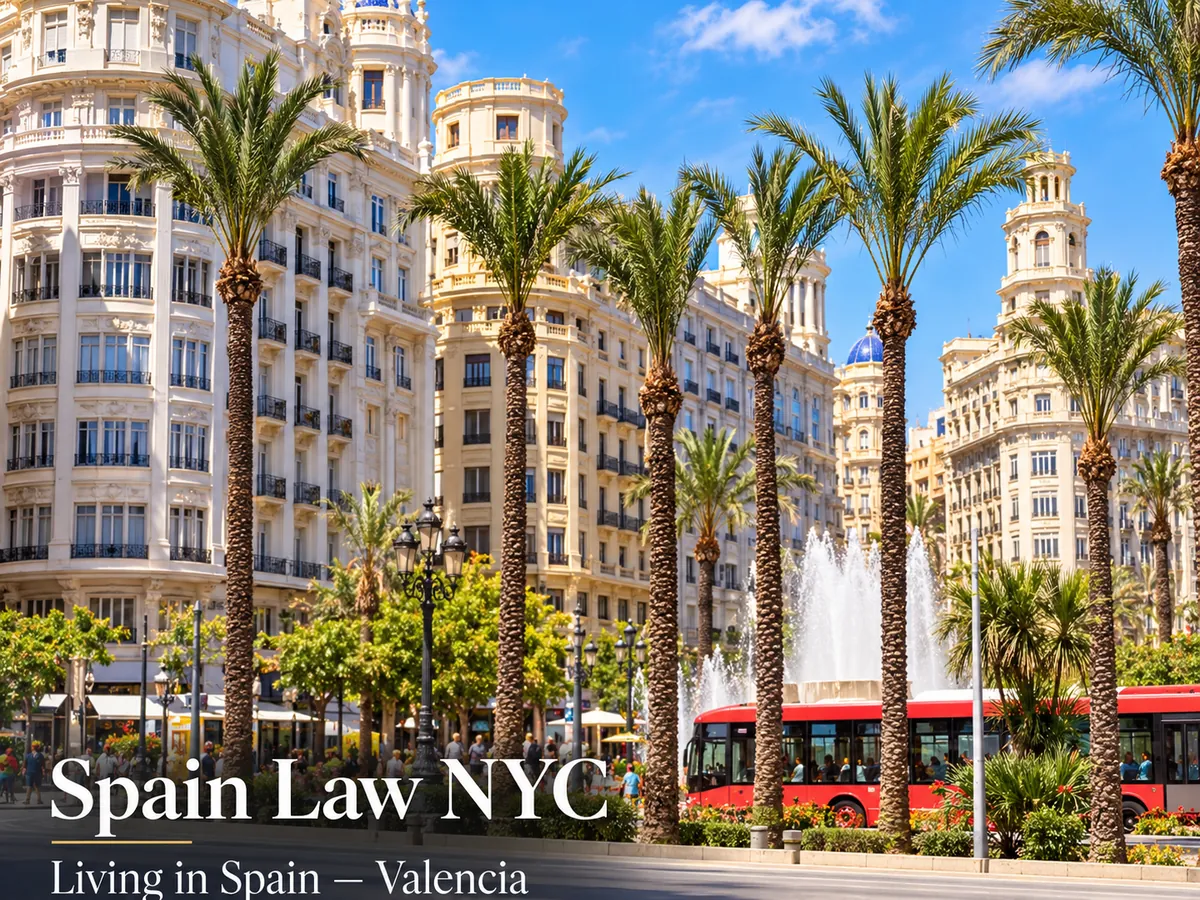
AI-assisted editorial view of a palm-lined Valencia plaza and residential architecture with Spain Law NYC branding.
Central Valencia mixes ornate residential blocks, palms, public space and everyday movement; neighborhood choice is often about how much of that activity you want outside your front door.
Comparison of Valencia neighborhoods and residential areas
AreaProfile / atmosphereTransportHousingFamiliesBeachNoise / tourismMain trade-off
Ciutat VellaHistoric core; maximum monuments, restaurants and walkingExcellent central access; much is best on footOlder stock; building quality/accessibility variesPossible, but not the quietest defaultNot beachfrontHighest visitor pressure in partsHistoric atmosphere vs noise/tourism/building constraints
Russafa / RuzafaRestaurants, cafés, design, nightlife; very socialWalkable to center; buses and nearby rail/metroHigh-demand Eixample stockWorks for urban families tolerant of activityCycle/transit rather than doorstepCan be lively lateEnergy and convenience vs noise and pressure
El Pla del Remei / Gran ViaPolished central Eixample; shopping, dining, classic blocksStrong walking, bus and metro accessPremium central housingGood if budget supports itNot beachfrontBusy urban streets; less visitor-saturated than core hotspotsPremium location vs price
Pla del RealGreen, established, university-adjacentStrong bus/metro links and cyclingMixed established apartments; sought-afterStrong fit near parks/schoolsEasy cycle/transitGenerally calmer than nightlife zonesResidential quality vs central premium
BenimacletNeighborhood identity, students, cafés, lower-rise pocketsMetro/tram + cyclingOften less expensive than Eixample, but demand is strongGood for mixed urban routinesTram/cycle accessibleStudent/social noise on some streetsCharacter and value vs uneven quietness
Cabanyal-Canyamelar / Les ArenesMaritime identity, beach life, restaurants, older housing fabricTram, bus, cyclingRenovated and unrenovated stock vary sharplyBlock-by-block decisionExcellentSummer/visitor pressure near seafrontBeach lifestyle vs tourism and housing variability
MalvarrosaResidential beach district with broad urban beachBus/tram; bike-friendlyApartment-heavy; quality variesCan work well for beach-focused familiesDoorstepSeasonal seafront activityDirect beach vs distance from central office districts
Patacona (Alboraya)Modern/seafront residential extension north of MalvarrosaBus/cycle; different municipalityBeach-premium marketPopular for seafront family routinesDoorstepBusy weekends/summerNot in València municipality; services/taxes/schooling geography can differ
CampanarResidential, newer pockets, services and larger roadsMetro/bus; easy outbound road accessMix of new and established apartmentsStrong family candidateCross-city tripLower tourist pressureSpace/services vs less historic atmosphere
Quatre Carreres / Ciutat de les ArtsModern landmark zone, Turia access, newer developmentBus, cycling; rail/metro access depends on exact blockNewer apartments common in selected areasGood for modern-housing prioritiesEasy cycle/bus to coastVisitor flows around attractionsModernity/Turia vs weaker old-neighborhood feel
Penya-rojaModern residential area between Turia/CAC and the port sideBus/cycle; reasonable metro access by locationNewer apartment blocks, often with amenitiesStrong family/remote-work fitCloser to beach than central districtsGenerally residentialModern comfort vs less historic street life

Municipal geography reference: Ajuntament de València — 2026 neighborhoods. Patacona reference: Turismo Alboraya — La Patacona.

Housing / rent

How expensive is renting in Valencia in 2026?

Housing is Valencia's clearest cost pressure. idealista's September 2026 advertised asking-rent indicator was €16.3/m²/month citywide. Central L'Eixample was €18.3/m², Ciutat Vella €18.9, Campanar €17.7, Poblats Marítims €16.5, Camins al Grau and Pla del Real €16.4, Quatre Carreres €16.0 and Benimaclet €14.5.

Private asking-rent data — current

The September 2026 idealista series measures advertised market asking prices and uses the portal's methodology. It does not tell you the final rent in a signed lease, nor does a citywide €/m² number translate into one universal monthly budget.

Official rental data — slower

València's municipal statistical yearbook separates portal listings from its official “Índice de alquiler de la vivienda.” At this review date, the published official rental-index tables in that series are for 2023. They are useful for structural district/barrier comparisons, but they are not a current September 2026 price quote.

Sources: idealista — September 2026 asking rents; Ajuntament de València Statistical Yearbook — housing/rental series.

Cost of living

Is Valencia cheap for an American?

Do not plan Valencia around a generic “American monthly budget.” Housing dominates the difference between households. A central renovated two-bedroom, an outer-district family apartment and a beach-front unit are different markets. The more reliable comparison is structural:

Housing

Material pressure and strong location premiums. Treat portal asking rents as a search indicator, not a guaranteed lease price.

Transport

Car ownership is often optional in connected neighborhoods. EMT's 2026 single ticket is €2; temporary discounted products run through December 31, 2026.

Education

Public education and private/international-school budgets are fundamentally different. School choice can change the best residential area.

Healthcare / insurance

Valencia has major public and private infrastructure, but your right to public coverage and any private-insurance requirement are legal/coverage questions.

Car

A car adds parking, fuel and ownership costs. Many inner-city households can avoid it; peripheral school/work routines may change that.

Lifestyle

Beach, parks and public space make many leisure routines low-cost, while frequent dining, premium gyms or constant U.S. travel can materially raise spending.

Climate

Valencia weather: mild winters, hot humid summers and a Mediterranean rain pattern

AEMET's 1981–2010 València station normal gives an annual mean of 18.3°C (64.9°F). January averages 11.8°C (53.2°F), while August averages 26.1°C (79.0°F), with an average daily high of 30.2°C (86.4°F). Relative humidity averages 65% annually and 68% in August.

Selected Valencia climate normals from AEMET
PeriodMeanAvg highAvg lowRainHumidity
January11.8°C / 53.2°F16.4°C / 61.5°F7.1°C / 44.8°F37 mm64%
July25.6°C / 78.1°F29.7°C / 85.5°F21.5°C / 70.7°F8 mm67%
August26.1°C / 79.0°F30.2°C / 86.4°F21.9°C / 71.4°F20 mm68%
October19.7°C / 67.5°F24.3°C / 75.7°F15.2°C / 59.4°F77 mm67%

The comfort trade-off is humidity. Summer nights remain warm, and heat episodes can exceed long-term normals. Rain is uneven: September and October are much wetter in the normal series than midsummer, and Mediterranean heavy-rain episodes can be intense. Long-term normals describe climate, not a promise about any specific year.

Source: AEMET — València station 8416, 1981–2010 normals.

AI-assisted editorial sunset over Valencia's historic skyline with Spain Law NYC Living in Spain branding.
Valencia's Mediterranean light is part of the lifestyle appeal, but summer comfort depends as much on humidity, cooling and building quality as on headline temperatures.

Sea & beaches

Does Valencia have a beach?

Yes—Valencia integrates broad Mediterranean beaches into a relatively compact city. Les Arenes/Cabanyal is the closest urban seafront to the port-side city, Malvarrosa continues north as Valencia's classic urban beach, and La Patacona continues the same coastal strip beyond the municipal boundary in Alboraya.

The practical advantage is not that other global cities lack coast. New York also has extensive waterfront, ocean frontage and public beaches. Valencia's difference is that a much smaller urban footprint puts the Mediterranean promenade and beach routine within an easier cycle/tram/bus radius for many residents.

Sources: Ajuntament de València — Malvarrosa; Turismo Alboraya — La Patacona.

Daily life, culture & food

The Turia, Fallas and food are not tourist add-ons—they shape resident life

Turia as everyday infrastructure

The former Turia riverbed is now a continuous green corridor used for running, cycling, playgrounds, sports and cross-city movement. For residents, proximity to the Turia can change how practical a neighborhood feels even when it is not in the historic center or on the beach.

Fallas changes March

Fallas is UNESCO-recognized intangible cultural heritage and fills March with neighborhood monuments, fireworks, processions and street activity. That is a cultural strength, but residents sensitive to noise, smoke or road closures should understand that the festival materially changes daily routines.

Local food is geographically rooted

Rice dishes and paella connect the city to l'Horta and Albufera; horchata connects daily food culture to chufa production around Valencia and Alboraya. Markets, neighborhood bars and long lunches matter more to resident life than a checklist of famous restaurants.

Sources: Visit València — Turia Garden; Visit València — UNESCO heritage / Fallas; Visit València — Valencian paella context.

Transport

Do you need a car in Valencia?

Usually no, if you live and work in the connected urban core. EMT buses, Metrovalencia metro/tram, Cercanías, walking and cycling can cover ordinary routines. A car becomes more useful for peripheral workplaces, certain school runs, frequent trips outside the metropolitan network or homes chosen primarily for space rather than transit.

EMT

Dense municipal bus network. Single fare €2 at the October 2026 review; discounted products are temporary and should be rechecked.

Metrovalencia

Metro and tram connect central districts, airport, university/beach corridors and metropolitan municipalities.

Cercanías

Useful for regional commuter corridors beyond the inner metro network; integrated SUMA products can combine operators by zone.

Bike / walk

Flat terrain and the Turia corridor make cycling unusually practical for cross-city travel.

AI-assisted editorial Valencia streetscape with palms, urban architecture and public transport, branded for Spain Law NYC.
Compact blocks, broad public spaces and transit corridors help make many central Valencia routines workable without a private car.

Sources: EMT València — 2026 fares; Generalitat Valenciana — integrated SUMA transport products; Metrovalencia.

Airport & United States

Does Valencia have direct flights to the United States?

No scheduled U.S. nonstop destination appears in Aena's current Valencia Airport list at the October 4, 2026 review. Aena lists 103 destinations and 39 airlines, including major European hubs such as Amsterdam, Frankfurt, Lisbon, London-Heathrow, Madrid and Paris-CDG, plus a Montreal service. U.S. trips therefore normally require a connection.

This is one of Valencia's clearest trade-offs versus Madrid and Barcelona. Both larger hubs offer stronger direct U.S. connectivity. Valencia can still be highly workable for occasional transatlantic travel because one-stop options are broad, but frequent U.S. travelers should price time and connection risk into the decision.

Source: Aena — Valencia Airport current destinations, reviewed October 4, 2026.

Rail

Valencia's mainland advantage is rail connectivity

Madrid

Renfe operates AVE, Avlo and long-distance services from València Joaquín Sorolla to Madrid. This is a genuine high-speed corridor.

Barcelona / Castelló

Renfe increased Euromed service in May 2026 to six Euromed trains per direction daily between València/Castelló and Barcelona, within 16 daily long-distance trains across the corridor.

Alicante

Euromed provides center-to-center links south toward Alicante, complementing regional/Cercanías corridors.

Sources: Renfe — València–Madrid; Renfe — May 20, 2026 Euromed increase; Renfe — València–Alicante.

Healthcare infrastructure

Valencia has major public hospital and primary-care infrastructure

Hospital Universitari i Politècnic La Fe is one of the city's major public hospitals. Its health department states that the hospital has 1,000 beds and is linked to 19 primary-care facilities (12 health centers and seven auxiliary clinics). Other public hospital departments, including Doctor Peset and Clínico-Malvarrosa, serve different parts of the city and metro area.

Infrastructure is not entitlement

The existence of public hospitals does not mean every newly arrived U.S. citizen automatically has public healthcare coverage. Entitlement, registration and any private-insurance requirement depend on legal and coverage circumstances. This destination guide deliberately does not decide those questions.

Source: Generalitat Valenciana — Valencia La Fe health department.

Families, schools & universities

For families, choose the school before you lock the housing search

School geography can matter more than a neighborhood ranking. Valencia has public, concertado, private and international-school options. Public-school language planning sits within the Valencian education framework, while international schools may use British, American, IB or other curricula depending on the institution. Admissions, fees, school transport and language models can change, so verify directly before signing a long lease.

Two major public universities shape the city's academic profile. Universitat de València expected approximately 50,000 students in 2026–27 across campuses including Blasco Ibáñez, Tarongers and Burjassot-Paterna. Universitat Politècnica de València has 15 schools/faculties across four campuses; its Valencia (Vera) campus is pedestrian and includes 125,000 m² of green areas.

Spanish & Valencian

Do Americans need to speak Valencian?

You can manage ordinary adult life in Valencia in Spanish, but Valencian is part of the institutional and educational environment. Article 6 of the Valencian Statute of Autonomy establishes Valencian and Castilian Spanish as official languages in the Comunitat Valenciana.

In practice, signage, municipal/Generalitat materials and schools can be bilingual. The current education framework gives families mechanisms around Valencian/Castilian base-language planning depending on school level and zone. For an American family, the useful step is not to enter a political language debate; it is to ask each candidate school exactly how instruction is organized for the relevant year.

Sources: BOE — Valencian Statute of Autonomy, Article 6; BOE — Valencian education law 1/2024.

Remote work & digital professionals

Valencia works well for remote professionals—if the U.S. time zone fits your life

The city combines fiber/mobile infrastructure, coworking, universities, an international community and a municipal innovation strategy without the scale of Madrid or Barcelona. València Innovation Capital's 2026 programming explicitly includes international digital professionals and local ecosystem connections.

The practical constraint is time-zone overlap. East Coast teams can push meetings into Valencia's late afternoon/evening; West Coast collaboration can move deep into the evening. Airport connectivity is good within Europe but U.S. travel normally requires a connection.

Legal boundary

This section describes the destination. It does not explain eligibility for Spain's international telework residence route.

Digital Nomad Visa legal guidance →

Business & startups

Valencia has a real—though smaller—technology and startup ecosystem

At the municipal 2026 strategy presentation, the City of València reported that the local innovation ecosystem had exceeded €200 million in investment captured during the prior year, supported more than 20,000 qualified knowledge-economy jobs and was valued near €4 billion. Those are municipal ecosystem figures, not a guarantee about an individual startup or salary.

The city's institutional network includes València Innovation Capital, Invest in Valencia, university innovation units and private ecosystem actors. VDS+ 2026 is scheduled for October 21–22 at the City of Arts and Sciences, bringing startups, investors and corporations together.

Sources: Ajuntament de València — 2026 innovation strategy; València Innovation Capital — VDS+ 2026.

Retirement fit

Is Valencia a good place to retire?

It can be an excellent lifestyle fit for retirees who want a flatter, walkable Mediterranean city rather than a resort-only environment. Beach access, public transport, major hospitals, markets, culture and mainland rail are real strengths. The compromises are summer humidity/heat, rising housing costs, limited direct U.S. air service and noise in nightlife/tourism zones.

Strong retirement criteria

  • ✓ Flat city and car-light neighborhoods
  • ✓ Beach + Turia outdoor life
  • ✓ Major public/private healthcare infrastructure
  • ✓ Rail to Madrid/Barcelona/Alicante
  • ✓ Residential areas away from nightlife

Questions to inspect closely

  • △ Lift/elevator and step-free access in older buildings
  • △ Summer cooling and insulation
  • △ Airport connection tolerance
  • △ Proximity to chosen hospital/healthcare network
  • △ Residence eligibility and insurance—separate legal issues
Legal planning for retiring in Spain from the USA →

Tourism & residential pressure

Tourism pressure is concentrated, not citywide

The resident experience differs sharply by area. Ciutat Vella sees the most obvious visitor concentration; Russafa mixes residential life with restaurants/nightlife; Cabanyal-Canyamelar and the seafront experience seasonal pressure; outer residential districts can feel much less tourism-driven.

The municipality reported on February 12, 2026 that registered tourist apartments had fallen 14% after the city moratorium, from 10,516 to 9,057, and that Ciutat Vella and Poblats Marítims led police complaints involving tourist apartments. The city's 2026 CATAV census is designed to monitor tourist-accommodation saturation by district and neighborhood outside the separate Ciutat Vella planning area.

Sources: Ajuntament de València — February 12, 2026 tourist-apartment update; CATAV tourist-accommodation census.

Destination comparison

Valencia vs NYC, Barcelona, Madrid and Tenerife

These are lifestyle filters, not rankings. Residence eligibility, work rights, tax and property law stay on the legal pages.

Valencia lifestyle comparison with New York City, Barcelona, Madrid and Tenerife
ComparisonValencia strengthOther destination strengthDecision point
Valencia vs NYCSmaller scale, shorter distances, Mediterranean beach/park routine, lower-intensity daily rhythmNYC has far deeper employment/cultural scale, 24-hour intensity, extensive waterfront/ocean beaches and unmatched U.S. connectivityCompact Mediterranean routine or global megacity depth?
Valencia vs BarcelonaSmaller scale, less intense tourism in many districts and lower September 2026 citywide asking-rent €/m² indicatorBarcelona has a larger international business/startup ecosystem and stronger direct long-haul/U.S. connectivitySmaller coastal-city rhythm or bigger global network?
Valencia vs MadridMediterranean coast, milder winter, beach access, flatter smaller scaleMadrid offers capital-city jobs/culture, national transport centrality and much stronger nonstop U.S. flyingCoastal lifestyle or national-capital depth?
Valencia vs TenerifeMainland rail, larger city/university ecosystem and easier peninsular travelTenerife offers island nature and milder winter coastal conditionsMainland compact city or island climate/outdoor identity?

Legal bridge

Renting or buying property in Valencia does not by itself create Spanish residence rights. Visa/residence eligibility, work authorization, tax analysis, healthcare entitlement, NIE procedure and property legal work are separate questions. This page intentionally does not reproduce those legal procedures.

Quick answers

Living in Valencia as an American — FAQ

Last reviewed: .

Is Valencia a good place for Americans to live?

Yes for people who value a compact Mediterranean city, urban beaches, public transport, universities, healthcare infrastructure and mainland rail. It is a weaker fit if direct U.S. flights, very deep corporate job markets or a fully English-speaking environment are priorities.

How expensive is Valencia in 2026?

Housing is the main pressure point. idealista's September 2026 advertised asking-rent indicator was €16.3/m²/month citywide, with central Ciutat Vella and L'Eixample higher. Other costs vary substantially by household.

What are the best neighborhoods in Valencia for Americans?

There is no universal best area. Russafa and central Eixample suit active urban life; Pla del Real can work well for green/university access; Benimaclet has neighborhood/student energy; Cabanyal and Malvarrosa prioritize the sea; Campanar and Penya-roja often fit family/newer-housing priorities.

Can you live in Valencia without a car?

Yes in many connected neighborhoods. EMT, Metrovalencia, Cercanías, cycling and walking cover many daily routines. Peripheral workplaces or specific school commutes can make a car more useful.

Does Valencia have a beach?

Yes. Les Arenes/Cabanyal and Malvarrosa form the main urban beach strip. La Patacona continues north but belongs to the neighboring municipality of Alboraya.

Does Valencia have direct flights to the United States?

No scheduled U.S. destination appears in Aena's current Valencia Airport list at the October 4, 2026 review. Travelers generally connect through Madrid or European hubs. Schedules can change.

Do I need to speak Valencian?

Spanish is enough for most day-to-day adult life, but Valencian and Spanish are co-official and Valencian is visible in administration, education, signage and local culture. Families should verify each school's current language model.

Is Valencia better than Barcelona for an American?

Neither is universally better. Valencia offers smaller scale and generally lower current citywide asking-rent pressure; Barcelona offers a larger international business ecosystem and stronger long-haul air connectivity.

Valencia vs Madrid: which is better to live in?

Valencia is stronger for beach access, smaller scale and a Mediterranean routine. Madrid is stronger for capital-city jobs, culture, national connectivity and direct U.S. flights.

Is Valencia good for retirees?

It can be: the city is relatively flat, public transport is strong, major hospitals are present and beach/park life is accessible. Summer heat/humidity, building accessibility, housing cost and one-stop U.S. flying are trade-offs.

Can I move to Valencia just by renting or buying property?

No. Housing and immigration status are separate. Long-term residence requires an appropriate legal basis.

Valencia fits. Now separate destination choice from legal route.

Use this guide to decide whether Valencia fits your life. Use the legal roadmap to determine how a move can lawfully be structured.