
Climate
Microclimates matter
AEMET normals put annual mean temperature at about 21.4°C / 70.5°F at Tenerife Sur, 21.5°C / 70.7°F in Santa Cruz and 16.8°C / 62.2°F at Tenerife Norte–La Laguna.
Living in Spain · Tenerife destination guide · reviewed October 4, 2026
Tenerife can be an excellent fit if you value year-round outdoor life, a mild coastal climate and a slower island rhythm — but the island is not one uniform “sunny Spain” experience. North and south differ materially in climate, housing pressure and daily atmosphere, while Santa Cruz, La Laguna, Puerto de la Cruz and Costa Adeje each suit different lifestyles.
This is a destination and lifestyle guide for U.S.-based readers. It does not replace immigration, tax, healthcare-eligibility or property-specific legal advice.
Direct answer
Tenerife offers several very different versions of island life within a relatively small area. Santa Cruz gives you the most urban daily routine; La Laguna adds a historic, cooler, university-city feel; Puerto de la Cruz combines a greener northern climate with established tourism; and Costa Adeje offers sunnier, highly international resort infrastructure at a substantially higher advertised rental level.
The island works particularly well for people who want outdoor access and a mild climate without giving up airports, hospitals, shopping and urban services. The trade-off is that island geography matters: some routines are easy without a car, others are not; U.S. travel normally requires a connection; and popular coastal housing markets can be expensive relative to local expectations.
The most important Tenerife decision is not “beach or no beach.” It is whether you prefer the greener, cloudier and generally more local-feeling north; the sunnier, drier and more tourism-oriented south; or the Santa Cruz–La Laguna metropolitan corridor.
Climate
AEMET normals put annual mean temperature at about 21.4°C / 70.5°F at Tenerife Sur, 21.5°C / 70.7°F in Santa Cruz and 16.8°C / 62.2°F at Tenerife Norte–La Laguna.
Connectivity
Tenerife Sur is strongly international. Tenerife Norte is especially useful for the other islands and mainland Spain.
Housing
September 2026 advertised rents ranged from 12.9 €/m² in La Laguna to 20.8 €/m² in Costa Adeje in the benchmark used below.
Tax / business context
The 2026 general IGIC rate is 7%, while qualifying ZEC entities can access a 4% corporate tax rate on qualifying taxable income subject to statutory conditions.
Where to live
There is no single “best” area. Your answer should follow your daily routine: urban services, climate preference, airport use, walkability, beach access, tourism intensity and whether you expect to drive.
| Area | Daily-life profile | Climate / feel | Main trade-off |
|---|---|---|---|
| Santa Cruz de Tenerife | Island capital, offices, shopping, culture, port activity and the strongest urban routine. | Warm coastal city; AEMET annual mean 21.5°C / 70.7°F. | You get city convenience rather than a “live on the beach” resort experience. |
| San Cristóbal de La Laguna | Historic center, university energy and direct tram connection with Santa Cruz. | Cooler because of elevation; Tenerife Norte station at 632 m averages 16.8°C / 62.2°F annually. | If your priority is guaranteed coastal sunshine, this is not the obvious choice. |
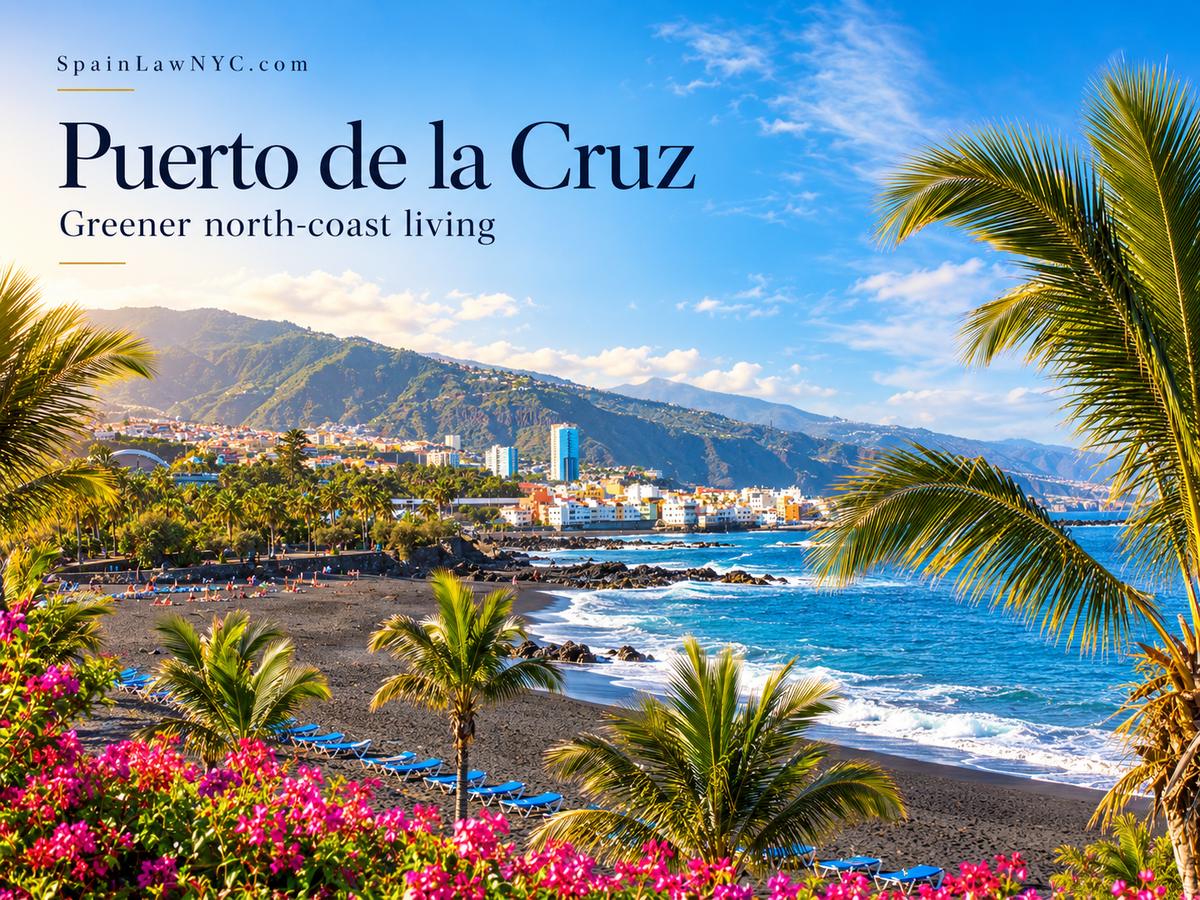
| Puerto de la Cruz | Established northern resort town with local residential life, restaurants, seafront and access to the greener north. | Greener and more humid; official Tenerife Tourism describes north-coast averages around 19–23°C / 66–73°F. | Northern weather is a benefit for some residents and the wrong expectation for others. |
| Costa Adeje / south | International resort infrastructure, beaches, restaurants and easy access to Tenerife Sur airport. | Drier and sunnier; Tenerife Sur annual mean 21.4°C / 70.5°F. | The highest asking-rent level among the four benchmark areas below. |
A smaller south-coast option for people who prioritize wind, water sports, an informal beach-town rhythm and proximity to Tenerife Sur airport. It is not a substitute for Santa Cruz if you want a full capital-city routine.
A mature southern tourism zone with dense services, bus links and a strong international presence. Expect more visitor activity and less separation between residential and tourism life.
Useful if you want greener landscapes, traditional towns and distance from the major southern resort belt, while accepting more humidity and greater usefulness of a car for many routines.
September 2026 housing snapshot
Housing is the clearest place where “Tenerife cost of living” becomes location-specific. The table below uses advertised rental-price data from idealista for September 2026. These are market asking-price indicators per square meter, not official government rents, not guaranteed transaction prices and not a quote for a particular apartment.
| Area | Advertised rent, Sep. 2026 | Year-on-year change | What it suggests |
|---|---|---|---|
| La Laguna | 12.9 €/m² | +7.5% | Lowest of this four-area benchmark, despite meaningful annual growth. |
| Santa Cruz de Tenerife | 14.0 €/m² | +5.8% | Urban capital pricing below the two tourism-heavy coastal examples here. |
| Puerto de la Cruz | 16.5 €/m² | −2.7% | Northern coastal demand still priced above Santa Cruz in this snapshot. |
| Costa Adeje | 20.8 €/m² | −0.4% | Highest asking-rent level in this benchmark, reflecting premium southern coastal pressure. |
Source: idealista market reports, September 2026. Idealista notes a methodology improvement from July 2026, so short-term comparisons should be read with that context. Housing stock, furnished status, exact neighborhood, season and lease length can materially change the price you actually see.
Your basket can be lower than New York for many everyday items, but imported goods and highly tourist-oriented locations can narrow that gap. This guide does not invent one “monthly grocery number” for every household.
Building type, air-conditioning use, elevation, household size and contract terms matter. Ask for actual prior bills when evaluating a long-term rental where possible.
A week in a resort zone is not a reliable model for resident life. Long-term housing, transport patterns and neighborhood choice dominate the practical budget.
Business & tax context
Yes, structurally — but not automatically for every person or company. The Canary Islands use IGIC rather than mainland VAT, with a 7% general rate in 2026. Separately, qualifying entities in the Zona Especial Canaria may apply a 4% Corporate Income Tax rate to the qualifying portion of taxable income, subject to registration, activity, investment, employment and other statutory conditions.
Useful context for consumption and operating costs, but 7% is not universal: the IGIC system contains other rates and exemptions for particular goods and services.
In Tenerife the statutory baseline generally includes €100,000 of qualifying investment within two years and at least five jobs within six months, together with Canary management/presence and an eligible activity. Legal exceptions and taxable-base limits apply.
This page gives destination context, not individual tax advice. U.S. founders also need U.S. federal/state and reporting analysis. See Canary Islands tax/business context and Cross-Border Tax Coordination.
Climate & geography
Tenerife's climate changes quickly with altitude and exposure. AEMET's 1981–2010 climate normals show that the low southern coast and Santa Cruz are much warmer than the La Laguna plateau, while Tenerife Tourism describes the north coast as greener, wetter and more humid than the south. For U.S. readers, the table shows both Celsius and Fahrenheit.
| Zone | Official climate indicator | Typical feel | Lifestyle implication |
|---|---|---|---|
| South coast / Costa Adeje / Granadilla | 21.4°C / 70.5°F annual mean January 18.4°C / 65.1°F · August 24.7°C / 76.5°F at Tenerife Sur Airport (64 m) | Drier, sunnier, low rainfall and resort-oriented. | Strongest fit for people prioritizing winter sun, beaches and outdoor routines. |
| Santa Cruz coast | 21.5°C / 70.7°F annual mean January 18.2°C / 64.8°F · August 25.5°C / 77.9°F at 36 m | Warm coastal capital with more urban life than resort life. | Good compromise for mild weather plus city services and car-light routines. |
| La Laguna / northern uplands | 16.8°C / 62.2°F annual mean January 13.1°C / 55.6°F · August 21.2°C / 70.2°F at Tenerife Norte Airport (632 m) | Cooler, cloudier and more humid; large contrast with Santa Cruz only a short distance away. | Attractive if you prefer cooler sleeping temperatures and less intense heat, but not if your goal is maximum sun. |
| North coast / Puerto de la Cruz / Orotava Valley | Official tourism range: about 19–23°C / 66–73°F on the north coast | Greener, wetter and more humid under the trade winds. | Good for residents who value vegetation and a less arid landscape over guaranteed sunshine. |
| Highlands / Teide | No single coastal-style average is useful; above 1,500 m the air is drier, day/night variation increases and winter snow can occur. | Mountain climate, strong UV exposure and large temperature swings. | Excellent for hiking and mountain access, but it should not be treated as an extension of the coastal climate. |

Climate references: AEMET — Tenerife Sur, AEMET — Santa Cruz, AEMET Tenerife Norte climate normals, and Tenerife Tourism — north/south contrast.
Relocation tip: spend time in the exact area you are considering before signing a long lease or buying. Tenerife's microclimates are too localized for one island-wide average to answer a housing decision.
Climate & health practicality
The defensible benefit is behavioral, not therapeutic. Mild conditions across much of the coast can make walking, cycling and other outdoor activity easier to maintain across more months of the year. The Servicio Canario de la Salud states that regular physical activity supports cardiovascular health, muscles and bones, mood, sleep and functional independence. That evidence supports the value of an active lifestyle — it does not mean Tenerife's climate itself cures or treats disease.
Mild coastal temperatures can make walking, swimming and outdoor exercise practical throughout much of the year, which may make consistent activity easier for some residents.
People who dislike stronger heat may prefer La Laguna or the north; those who prioritize sun may prefer the south. Comfort is individual, and medical conditions can change what is appropriate.
Canary health authorities maintain heat-risk plans. High UV, extreme-heat episodes and Saharan dust (calima) can require reduced exertion, hydration and extra caution, especially for vulnerable people.
Health references: Servicio Canario de la Salud — physical activity and heat-risk prevention plan.
Getting around
Yes in some lifestyles, but not equally well everywhere. TITSA operates the island bus network, and the Santa Cruz–La Laguna metropolitan corridor also has tram service. A central urban routine can be workable without daily driving. A car becomes much more useful for dispersed hillside neighborhoods, remote beaches, hiking areas, cross-island errands and schedules that do not align well with public transport.
The strongest case for a car-light lifestyle, especially if home, work and social life sit close to tram and frequent bus corridors.
Bus service is substantial, but your exact urbanization and work pattern matter. Some residential developments are much easier with a car.
Car access becomes much more important when your daily life depends on small inland towns, trailheads or cross-island movement.
TITSA publishes a current fare calculator rather than one universal island fare. Check the specific line and origin/destination when budgeting a commute.
Air connections
Tenerife is unusually well connected for an island of its size, but the two airports play different roles. Aena's current schedules list 96 destinations served by 41 airlines at Tenerife Sur, with extensive European service. Tenerife Norte-Ciudad de La Laguna currently lists 29 destinations served by 7 airlines, concentrated on the Canary Islands, mainland Spain and a small number of other routes.
Best aligned with international Europe-heavy connectivity and south-island living. Current schedules include major European cities and multiple UK, German, French, Italian and other routes.
Especially useful for inter-island travel and mainland Spain. It is much closer to La Laguna and the northeast than the southern airport.
For U.S. movers: Aena's current destination lists do not show New York. Plan on a connection — commonly through mainland Spain or another European hub — and check current airline schedules before relying on a specific routing.
Culture & everyday life

Carnival is a major part of the capital's cultural identity, not merely a tourist event. Santa Cruz's city government notes that the celebration has held Spain's International Tourist Interest designation since 1980.
UNESCO inscribed San Cristóbal de La Laguna in 1999. Its historic grid, architecture and lived-in center give it a very different atmosphere from Tenerife's resort coast.
Expect local staples such as papas arrugadas with mojo, fish, gofio and regional cheeses. In the north, informal guachinche-style dining is part of the local food culture around wine-growing areas.
The practical advantage of Tenerife is variety: ocean, volcanic landscapes, pine forest, Anaga's greener terrain and high-altitude Teide environments can all sit within one island routine.
Healthcare practicality
Tenerife has public healthcare infrastructure through the Servicio Canario de la Salud, including major hospital services in the metropolitan area and Hospital del Sur in Arona. The Canary health service states that Hospital del Sur serves the southern municipalities including Adeje, Arona, Granadilla de Abona, Guía de Isora and others.
Access is a separate issue from physical availability. Whether a U.S. mover can use Spain's public system, needs private insurance, or has another coverage route depends on legal and personal circumstances. This destination guide does not treat hospital presence as proof of individual coverage.
A relaxed social rhythm does not mean administrative processes move informally. Appointments, registrations and Spanish paperwork still need planning.
You can hear a lot of English in southern resort areas, but building a durable local life is easier with functional Spanish.
A journey that looks short on a map can involve altitude, winding roads or traffic. Test real travel times for the routines that matter to you.
Tenerife can cost less than NYC in many categories, but southern housing pressure and imported goods mean the island should not be sold as uniformly cheap.
Why it works
Why it may not
From a lifestyle perspective, often yes. Retirement appeal comes from climate, outdoor access and the ability to choose between quieter northern areas and service-rich southern zones. Remote workers may value European time alignment, connectivity and year-round outdoor life.
But lifestyle fit is not immigration eligibility. Spain's residence rules distinguish non-working residence from international telework and other activities. If your move depends on retirement income or remote employment, the legal route must be assessed separately rather than inferred from the destination.
Legal bridge
A U.S. citizen who wants to reside in Tenerife long term needs an appropriate Spanish legal basis for residence. The correct route depends on what the person will do in Spain, how income is earned, family circumstances and other facts. Renting or purchasing a home in Tenerife does not itself create residence rights.
Spain Law NYC keeps those legal questions on the pages built to answer them rather than duplicating immigration checklists here.
Find the Spanish legal route that matches the move.
Coordinate several Spain-side legal workstreams.
Separate legal guidance for buyers in Tenerife and the islands.
Coordinate Spain-side issues with independent qualified tax professionals.
Quick answers
Last reviewed: .
It can be, especially if you value mild weather, outdoor life and an island scale with meaningful infrastructure. The decisive issue is choosing the right part of the island for your routine.
The north is generally greener, wetter and more humid; the south gets more sunshine and is more tourism-oriented. La Laguna's elevated north is also materially cooler than the southern coast.
AEMET annual climate normals are about 21.4°C / 70.5°F at Tenerife Sur, 21.5°C / 70.7°F in Santa Cruz and 16.8°C / 62.2°F at Tenerife Norte–La Laguna. The north coast is commonly described around 19–23°C / 66–73°F.
Mild weather can make regular outdoor activity easier to maintain, and physical activity has well-established health benefits. That is different from claiming that the climate itself treats disease. Heat, UV and calima can also create health risks.
In the September 2026 idealista asking-rent data used here, La Laguna was 12.9 €/m², Santa Cruz 14.0 €/m², Puerto de la Cruz 16.5 €/m² and Costa Adeje 20.8 €/m². Actual homes vary materially.
Not for every lifestyle. Central Santa Cruz and La Laguna offer the strongest car-light case. Dispersed residential zones, hiking access and many cross-island routines are easier with a car.
Yes, with an appropriate Spanish legal basis for residence. The correct route depends on your circumstances, and housing ownership or a lease does not itself grant Spanish residence.
Use the destination guide to decide where. Use the legal roadmap to decide how to establish the move lawfully.
Last reviewed: October 4, 2026. Destination conditions, transport schedules and housing-market indicators can change. Dated market indicators are contextual rather than guaranteed prices; check the linked source before relying on a time-sensitive figure.