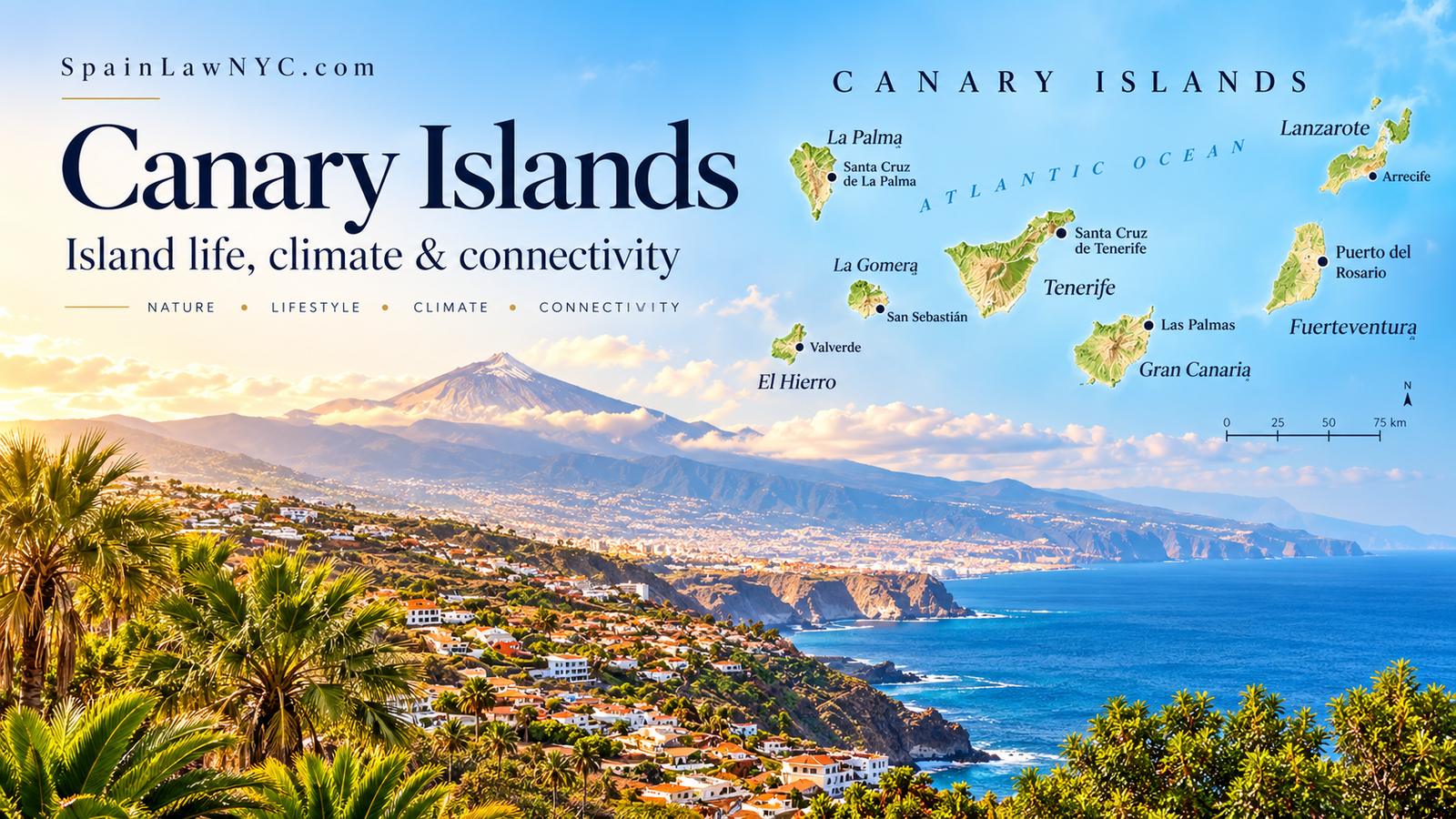
Archipelago
8 main islands
Tenerife, Gran Canaria, Lanzarote, Fuerteventura, La Palma, La Gomera, El Hierro and La Graciosa.
Living in Spain · Regional guide · reviewed October 4, 2026
The Canary Islands combine Spanish and European daily life with Atlantic-island geography, year-round outdoor potential and a distinctive economic framework. They use IGIC rather than mainland VAT, qualifying businesses may access the ZEC regime, and climate can change sharply with island, coast and altitude.
It is Spanish and European daily life with a distinctly island geography and tax environment. Distance from mainland Spain affects travel, logistics and the rhythm of life. Climate is generally mild at lower elevations, while trade winds, exposure and altitude create large local differences. The practical experience therefore depends less on the phrase “Canary Islands” than on the specific island, municipality and elevation you choose.
Do not choose the archipelago from a weather app or tax headline alone. Tenerife itself shows why: its north is greener and more humid, its south is sunnier and drier, and its uplands are much cooler. Likewise, the 7% general IGIC rate and the 4% ZEC rate do not mean every purchase or every company receives the same tax treatment.
Geography & European identity
Both descriptions matter, but in different senses. Geographically, the Canary Islands sit in the Atlantic Ocean in Macaronesia, immediately off the northwest coast of Africa. The Government of the Canary Islands places the archipelago about 97 km / 60 miles from Morocco and Western Sahara and roughly 1,400 km / 870 miles from the Iberian Peninsula. Legally and politically, however, Canarias is an autonomous community of Spain and an integral outermost region of the European Union. It uses the euro and participates in the European legal and institutional framework.
Archipelago
Tenerife, Gran Canaria, Lanzarote, Fuerteventura, La Palma, La Gomera, El Hierro and La Graciosa.
Smaller islands
Alegranza, Montaña Clara, Roque del Este, Roque del Oeste and Lobos.
Africa proximity
The eastern islands lie close to the northwest African coast.
Political status
European institutions and currency in an Atlantic territory geographically outside continental Europe.
Official references: Government of the Canary Islands — geography and composition; European Commission — EU outermost regions.
Quick facts
| Topic | 2026 context | Why it matters |
|---|---|---|
| Composition | 8 main islands + 5 islets | The archipelago is much more varied than a single “Canary Islands” lifestyle. |
| Geographic position | Atlantic / Macaronesia, about 97 km from northwest Africa | Explains the subtropical latitude, African dust episodes and strategic Atlantic position. |
| European status | Autonomous community of Spain; EU outermost region; euro area | Combines remote-island geography with the institutional framework of Spain and the EU. |
| Indirect tax | General IGIC: 7% | Canary Islands consumption taxation is structurally different from mainland Spain. Other IGIC rates and exemptions also exist. |
| ZEC business regime | Special corporate tax rate: 4% | Only for qualifying ZEC entities and the qualifying portion of their taxable base; registration and substantive conditions apply. |
| Tenerife / Gran Canaria ZEC entry conditions | Normally €100,000 investment in the first 2 years + at least 5 jobs within 6 months | Useful for genuine business-location planning, but not a plug-and-play “4% company” structure. |
| Climate | Subtropical with major island and altitude variation | A coastal climate profile cannot be assumed for La Laguna, the mountains or every island. |
| U.S. travel | Usually requires a European or mainland-Spain connection | Airport choice and connection patterns matter for frequent U.S. travelers. |
Volcanic archipelago
Every main Canary Island is volcanic in origin, but they are not geologically interchangeable. Some preserve very young lava fields and historical eruptions; others are ancient volcanic buildings reshaped by millions of years of erosion. That difference explains much of the archipelago's extraordinary variety in color, relief, vegetation, beaches and settlement patterns.
| Island | Volcano / volcanic landmark | What makes it distinctive |
|---|---|---|
| Tenerife | Teide–Pico Viejo complex; Chinyero | Teide is Spain's highest peak. Tenerife grew from several volcanic massifs and later the Las Cañadas / Teide–Pico Viejo system. Chinyero's 1909 eruption was the island's most recent historical eruption. |
| Gran Canaria | Caldera and Pico de Bandama | An older island with long volcanic cycles and major erosion. Bandama is one of its clearest recent-Holocene volcanic landscapes, with a roughly kilometre-wide caldera near Las Palmas. |
| Lanzarote | Timanfaya / Montañas del Fuego; Volcán del Cuervo | The eruptions of 1730–1736 transformed a large part of the island; further eruptions occurred in 1824. Young lava fields, geothermal heat and vineyards planted in volcanic ash define its visual identity. |
| Fuerteventura | Calderón Hondo / Bayuyo; Volcán de Gairía | The geologically oldest main island, around 22 million years old. Its long erosion history created broad plains, old massifs and huge beaches; no eruption has occurred in roughly the last 10,000 years. |
| La Palma | Cumbre Vieja; Teneguía; 2021 Cabeza de Vaca eruption | One of the archipelago's youngest and most volcanically active landscapes. Cumbre Vieja contains the historic eruption corridor; Teneguía erupted in 1971 and a new eruption occurred in 2021. |
| La Gomera | Roque Agando and the central volcanic plugs | Volcanic in origin but without a major eruption for roughly 2.5 million years. Erosion now dominates its identity: deep barrancos, dramatic roques and the humid Garajonay highlands. |
| El Hierro | Tagoro submarine volcano; three volcanic rifts | The youngest and westernmost island. IGN identifies more than 500 surface volcanic cones; the 2011–2012 submarine eruption south of La Restinga built the Tagoro volcano. |
| La Graciosa | Montaña Amarilla, Montaña Bermeja, Agujas Grandes | The smallest inhabited Canary Island, north of Lanzarote, with sandy tracks rather than paved roads, low volcanic cones and strong visual contrast between ochre, black lava, white sand and turquoise water. |
The five smaller islets named by the Government of the Canary Islands are Alegranza, Montaña Clara, Roque del Este, Roque del Oeste and Lobos. Most belong to the eastern Chinijo/Lanzarote–Fuerteventura system.
Geology references: Instituto Geográfico Nacional — volcanic relief of the Canary Islands; Government of the Canary Islands educational geology resources; IGN volcano monitoring for La Palma and El Hierro.
Europe, winter sun & an emerging U.S. market
For Europeans, the appeal is unusually simple to understand: a subtropical Atlantic climate, beaches and volcanic landscapes combined with Spanish infrastructure, the euro and dense air links to major European cities. That makes the islands especially important as a winter-sun destination when northern and central Europe are colder and darker.
The scale is not rhetorical. Turismo de Canarias reported more than six million British tourists a year in its 2025 UK market material, while Germany accounts for about 16% of total Canary tourism and is the second-largest source market after the United Kingdom.
This does not mean “every European goes to Canarias”; it means the archipelago has one of Europe's most mature winter-sun tourism markets.
The official 2024 U.S. tourist profile recorded about 80,000 U.S. tourists, representing 0.5% of the total market. The comparable 2019 profile reported 31,700 U.S. tourists over age 15. In 2024, 63.6% of U.S. Canary visitors traveled to Tenerife. U.S. visitors also over-index for landscapes, environmental quality, hiking, culture and local gastronomy.
That supports a real growth story in U.S. awareness and visitation. It does not by itself prove that permanent American relocation is increasing at the same rate; tourism and migration are different datasets.
Market references: Turismo de Islas Canarias / ISTAC, 2024 U.S. tourist profile and current market-development materials; Turismo de Islas Canarias 2025 UK and German market reporting.
The “Canary paradise” idea
The phrase can sound like tourism marketing, but there are concrete reasons residents and repeat visitors use it: mild coastal temperatures, Atlantic light, beaches, volcanic mountains, protected landscapes, dramatic biodiversity and the ability to spend much of the year outdoors. The deeper advantage is choice: dry eastern islands, green western mountains, major cities, tiny villages, resort zones and near-empty landscapes all exist inside the same Spanish region.
Marine influence and the trade-wind regime help moderate temperatures and are central to the islands' climate and everyday outdoor feel.
Beaches, lava fields, forests, cliffs and mountain trails are not remote expedition destinations; on many islands they can be part of an ordinary weekend.
Residents live under Spanish institutions and EU law, use the euro and remain connected to major European markets while physically living beside Africa.
“Canary lifestyle” is not one thing: Lanzarote's lava fields, Fuerteventura's open beaches, Tenerife's microclimates and La Gomera's green ravines create very different routines.
Ocean exposure, marine aerosol and trade winds are real environmental features, and Canary public-health material has historically noted relatively low local-origin particulate pollution compared with the importance of incoming African dust. But air quality is not permanently pristine. Saharan dust episodes — calima — can sharply increase PM10 and PM2.5 and are associated with respiratory risk, especially for sensitive people.
So the responsible claim is: the islands offer an oceanic, outdoor-oriented environment with frequent ventilation and mild conditions, but no place should be marketed as medically “pure air.” Servicio Canario de la Salud — air quality and calima.
Economic context
The Canary Islands have a specific Economic and Fiscal Regime designed around their status as an outermost European region. Two concepts are particularly relevant to Americans comparing the islands with mainland Spain: IGIC for indirect taxation and the Zona Especial Canaria (ZEC) for qualifying business activity.
IGIC
Canary Islands transactions use the Impuesto General Indirecto Canario rather than mainland VAT. The general IGIC rate is 7% in 2026, but the system also contains zero, reduced, increased and specific rates depending on the transaction. The practical benefit is a lower general indirect-tax rate than many U.S. movers expect from mainland European consumption taxes, but not every item is taxed at 7%.
Official reference: Agencia Tributaria Canaria — current IGIC rates.
ZEC
Spanish law sets a 4% Corporate Income Tax rate for the qualifying portion of taxable income of ZEC entities. It is not automatic. A qualifying entity or branch must be registered, have Canary Islands management/presence, conduct an eligible activity and satisfy investment and employment rules. In Tenerife and Gran Canaria the statutory baseline is generally €100,000 of qualifying investment within two years and at least five jobs within six months, subject to the law's exceptions and detailed conditions.
Official references: Law 19/1994 (BOE) and the Consorcio de la Zona Especial Canaria.
Important for U.S. founders: a favorable Spanish or Canary Islands regime does not answer U.S. federal or state tax questions, entity classification, reporting obligations or treaty analysis. Spain Law NYC treats this as a coordination issue rather than promising a “4% total tax” outcome. See Cross-Border Tax Coordination.
The larger islands have broad air links, but U.S. travel generally means a connection. Frequent transatlantic travel can make airport location and schedule resilience more important than beach proximity.
An urban capital, a historic university city and a tourism-heavy coastal zone can feel like completely different places even on the same island.
Public transport covers major corridors, but dispersed residential areas, trail access and cross-island routines can make a car substantially more useful.
Tourism demand and limited island supply can put pressure on long-term rentals in popular coastal areas. “Island life” should not be assumed to mean inexpensive housing.
Sun exposure, wind, humidity and elevation vary materially over short distances. Visit the areas you are considering at the times of day you would actually live there.
Current destination
Tenerife is large enough to offer several distinct relocation profiles: Santa Cruz for urban services, La Laguna for a cooler historic setting, Puerto de la Cruz for the greener north, and Costa Adeje and the wider south for sunnier resort-oriented living. The guide compares them with current housing indicators, AEMET climate normals and present airport connectivity.
Destination Guide
North vs south, areas, climate in °C and °F, transport, rent context, culture, healthcare practicality, remote-work and retirement appeal, plus the reasons Tenerife may not suit everyone.
Quick answers
Last reviewed: .
There are eight main islands: Tenerife, Gran Canaria, Lanzarote, Fuerteventura, La Palma, La Gomera, El Hierro and La Graciosa. The Government of the Canary Islands also lists five islets: Alegranza, Montaña Clara, Roque del Este, Roque del Oeste and Lobos.
Geographically they lie in the Atlantic close to northwest Africa; politically and legally they are part of Spain and an integral outermost region of the European Union. The islands use the euro.
Yes. All are volcanic in origin, but their age and activity differ greatly. Fuerteventura is the oldest main island; El Hierro is the youngest. Historical or recent eruptions are especially associated with Lanzarote, Tenerife, La Palma and El Hierro.
Yes as a tourism market. The official 2024 profile recorded about 80,000 U.S. tourists, compared with 31,700 in the 2019 profile. U.S. tourism remains a small share of the total, and tourism data should not be treated as proof of permanent migration.
The general rate is 7%. Other rates and exemptions apply to particular goods and services, so the correct tax treatment still depends on the transaction.
It is a statutory special rate for qualifying ZEC entities and the qualifying portion of their taxable base. It is not an automatic 4% rate for every company operating in the islands.
No. Registration, management presence, eligible activities, investment and employment conditions apply. Tenerife and Gran Canaria generally use a €100,000 investment baseline and five-job minimum, with statutory exceptions and detailed rules.
No. Island, coast, altitude and exposure to trade winds create substantial microclimates. Tenerife alone can move from warm coast to cool, humid uplands and winter snow at high altitude.
Yes, if the person has an appropriate Spanish legal basis for long-term residence. The Canary Islands do not create a separate immigration system for Americans: residence status is a Spanish-law question. The correct route depends on the person's circumstances, and a lifestyle or tax guide should not substitute for individual legal analysis.
Assess the Spanish residence framework that matches the move.
Separate legal guidance for buying and due diligence.
Coordinate Spanish and U.S. tax questions with qualified professionals.
Coordinate multiple Spanish-law workstreams after the destination decision.
The first full destination guide compares climate, neighborhoods, cost, connectivity and daily life — not just “sun and beach.”
Read the Tenerife destination guideLast reviewed: October 4, 2026. Destination conditions, transport schedules and housing-market indicators can change. Dated market indicators are contextual rather than guaranteed prices; check the linked source before relying on a time-sensitive figure.