
Barceloneta
Best for central access and beach-at-the-door living; busiest and most tourism-exposed.
Living in Spain · Barcelona
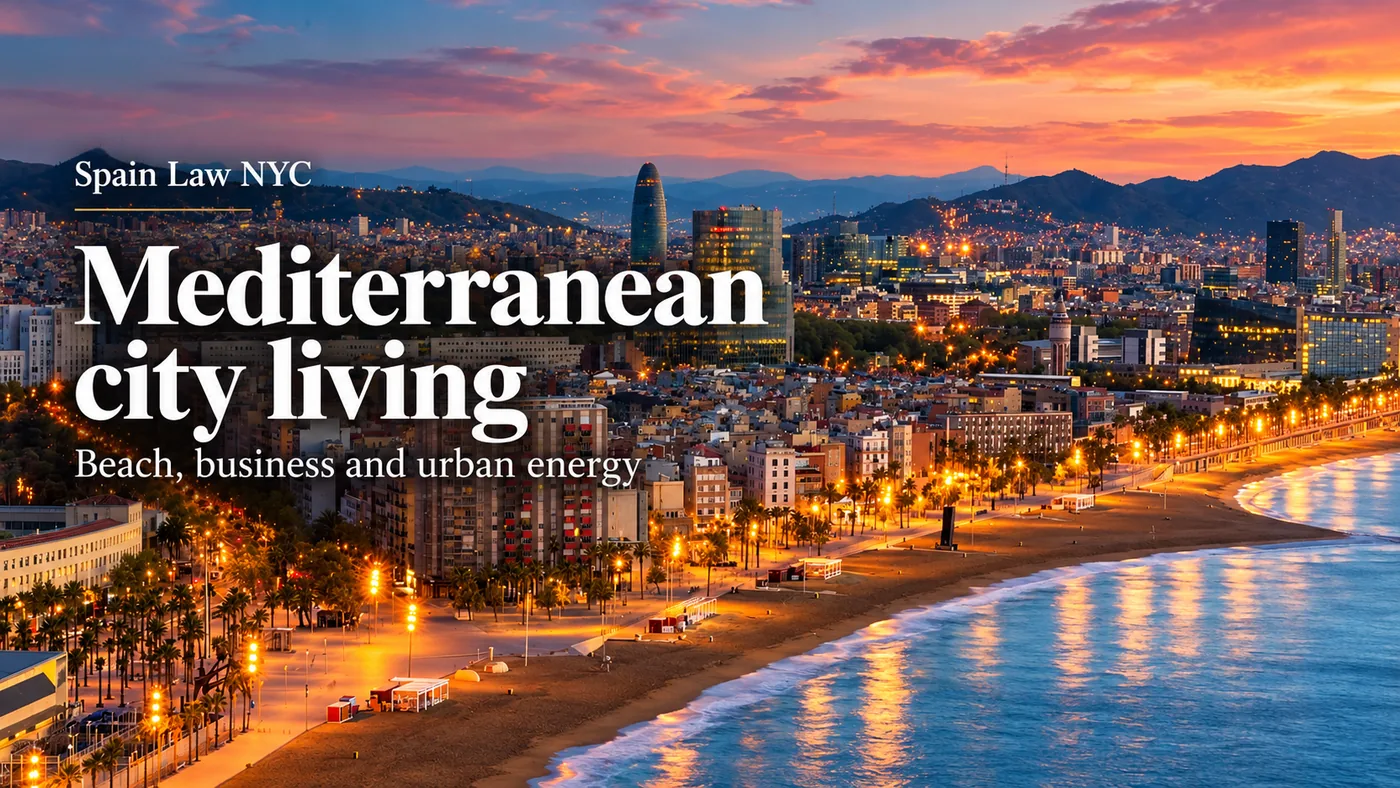
Barcelona is one of Spain's strongest choices for Americans who want a major European city with Mediterranean beaches, dense public transport, international business connections, universities and a startup ecosystem, while still supporting a car-light routine in many neighborhoods. The main trade-offs are housing pressure, tourism intensity, summer humidity, crowded central districts and a bilingual Catalan-Spanish public environment that newcomers should understand rather than ignore.
Compared with New York City, Barcelona is smaller and lower-rise, with its Mediterranean beaches woven into a more compact central-city footprint. New York also has extensive waterfront and ocean beaches, but at a much larger metropolitan scale. Compared with Madrid, Barcelona trades the capital's central rail geography and larger national-government ecosystem for direct Mediterranean access and a milder coastal winter. Compared with Tenerife, it offers much stronger mainland rail and European-city connectivity, but with higher urban density and less year-round climate stability.
Last reviewed: October 4, 2026. Rent indicators, transport fares and flight schedules are dated because they change.
Direct answer
Barcelona is a dense Mediterranean city of about 1.73 million registered residents, with broad public transport, direct beach access, two co-official languages and strong international connectivity. For many U.S. movers, the key question is not whether Barcelona has infrastructure—it does—but whether the housing cost, tourist pressure and bilingual local context fit the daily routine they want.
| Factor | Current context |
|---|---|
| Population | 1,729,963 registered residents as of January 1, 2026, according to Barcelona City Council. |
| Setting | Mediterranean coast, compact urban core, hills to the northwest and a long seafront. |
| Languages | Catalan and Spanish are co-official in Catalonia. Spanish is widely usable; Catalan matters in institutions, schools and local culture. |
| Climate | Mild coastal winters and warm, humid summers. AEMET Barcelona Airport normals show a 16.1°C / 61.0°F annual mean. |
| Official rent context | €1,137.35 average monthly registered rent citywide for January–March 2026 in Generalitat data. |
| September 2026 asking rent | €20.1/m²/month citywide on idealista. This is a private advertised asking-rent indicator, not an official signed-contract measure. |
| Public transport | Metro, bus, tram, FGC and Rodalies/Cercanías provide broad coverage; the 2026 discounted 1-zone T-usual is €22.80. |
| Airport | Josep Tarradellas Barcelona-El Prat (BCN); Aena currently lists 211 destinations operated by 91 airlines. |
| Car | Usually unnecessary for a central-city routine; more useful for outer-suburban, school, mountain or regional travel patterns. |
| Best fit | Urban professionals, remote workers, international families, students, culture-focused retirees and people who want city life plus a beach. |
| Main trade-offs | Housing pressure, tourism density, central noise, smaller/older apartments, humid summer heat and a more complex language context than Madrid. |

Neighborhoods
Barcelona changes quickly from district to district. A central apartment in the Gothic Quarter can deliver architecture and walkability but also tourism, nightlife and older-building compromises. Sarrià-Sant Gervasi can feel calmer and more residential but costs more. Poblenou offers beach and tech-district access, while Eixample is the broadest all-round central choice for many newcomers.
| Area | Profile | Atmosphere | Transport / walkability | Housing pattern | Families / international fit | Main trade-off |
|---|---|---|---|---|---|---|
| Eixample | Central all-rounder | Grid streets, Modernista architecture, restaurants and services | Excellent | Classic apartment blocks; lifts and renovation quality vary | Strong for professionals and many families | Price, traffic and noise on major corridors |
| Gràcia | Village-like central neighborhood | Plazas, local commerce, dense social life | Very good | Older, often smaller buildings on narrower streets | Popular with younger professionals and families | High demand, noise around plazas, limited space |
| Sarrià-Sant Gervasi | Premium residential | Quieter, greener, more residential and uphill | Good; varies by sub-area | Larger homes and premium apartments are more common | Strong family/international-school profile | Highest official district-level average rent in Q1 2026 |
| Les Corts | Residential + business/university | Calmer and more functional than tourist-center districts | Very good | Mix of mid-century and newer apartments | Good for families and institutional access | High prices and less historic-center atmosphere |
| Poblenou / Sant Martí | Beach + tech district | Former industrial fabric, 22@ offices, newer residential pockets | Very good | Mix of conversions, newer apartments and older stock | Strong for tech/remote workers and beach-oriented families | Changing blocks and premium seafront pricing |
| El Born | Historic-center culture and nightlife | Museums, restaurants, narrow medieval streets | Excellent on foot | Older buildings; natural light, lifts and soundproofing vary | Better for urban lifestyle than space-seeking families | Tourism/noise and older-building constraints |
| Gothic Quarter / El Gòtic | Maximum historic-center immersion | Iconic architecture, visitors, late activity | Excellent on foot | Historic housing; layout and condition matter greatly | Best for center access over quiet/space | Highest tourist intensity and street noise |
| Barceloneta | Beach-front urban living | Dense, social and intensely connected to the seafront | Excellent on foot | Traditionally compact apartments | Strong for beach-first singles/couples | Tourism, beach crowds and tight housing stock |
| Sant Antoni / Poble-sec | Central-adjacent urban | Food, local commerce and nightlife access | Very good | Older apartment stock with mixed renovation quality | Broad mixed profile | Street noise and limited larger units in some blocks |
| Sant Andreu / Horta-Guinardó | More local residential alternative | Less tourist-centered, neighborhood-oriented | Good; commute depends on address | More variation in size and age | Useful for families prioritizing routine/value | Farther from beach/center depending on sub-area |
“El Born” is a commonly used local/visitor label rather than a standalone municipal district; much of the area sits within Sant Pere, Santa Caterina i la Ribera in Ciutat Vella. For data, official district or neighborhood boundaries are more reliable than marketing labels.

Housing market
The Generalitat's registered rental data put Barcelona's average monthly rent at €1,137.35 for January–March 2026. District averages ranged from €816.57 in Nou Barris to €1,599.89 in Sarrià-Sant Gervasi. Separately, idealista's September 2026 advertised market indicator was €20.1/m²/month citywide.
Do not treat those figures as interchangeable. The Generalitat series is an official registered-contract measure; idealista is a private asking-price indicator based on advertised listings and notes a methodology improvement from July 2026. A specific apartment can differ sharply by street, size, condition, furnishing, lift, light, terrace, season and lease structure.
| District | Official average monthly rent, Jan–Mar 2026 | idealista asking rent, Sep 2026 |
|---|---|---|
| Barcelona city | €1,137.35 | €20.1/m² |
| Ciutat Vella | €1,011.41 | €22.1/m² |
| Eixample | €1,250.44 | €20.7/m² |
| Les Corts | €1,289.35 | €20.9/m² |
| Sarrià-Sant Gervasi | €1,599.89 | €20.4/m² |
| Gràcia | €1,081.25 | €19.9/m² |
| Sant Martí | €1,100.03 | €20.3/m² |
Sources: Generalitat rental statistics and idealista September 2026 asking-rent report. idealista is a private market source, not an official rent register.
Cost of living
A single “Barcelona monthly budget” is usually misleading because housing dominates the spread. Someone renting a renovated two-bedroom in Eixample or Sarrià lives in a different cost structure from someone in a smaller apartment in Sant Andreu. Transport, by contrast, can remain relatively predictable for residents who use the integrated network.
Groceries, restaurants, gyms, private insurance, childcare, international schools and entertainment vary too much by household to turn into one responsible number. Price the actual neighborhood and housing standard first, then build the rest of the budget around your own family pattern.
Climate
AEMET's 1981–2010 normals for Barcelona Airport—on the coastal plain at El Prat de Llobregat—show a 16.1°C / 61.0°F annual mean. January averages 9.2°C / 48.6°F. August averages 24.4°C / 75.9°F, with an average daily high of 28.5°C / 83.3°F and low of 20.2°C / 68.4°F. The station is a useful low-elevation coastal reference, not a promise that every neighborhood feels identical.
| Period | Mean | Average high | Average low | Precipitation |
|---|---|---|---|---|
| January | 9.2°C / 48.6°F | 13.6°C / 56.5°F | 4.7°C / 40.5°F | 37 mm |
| April | 13.7°C / 56.7°F | 18.0°C / 64.4°F | 9.4°C / 48.9°F | 40 mm |
| July | 23.9°C / 75.0°F | 28.0°C / 82.4°F | 19.8°C / 67.6°F | 21 mm |
| August | 24.4°C / 75.9°F | 28.5°C / 83.3°F | 20.2°C / 68.4°F | 62 mm |
| October | 17.8°C / 64.0°F | 22.1°C / 71.8°F | 13.5°C / 56.3°F | 91 mm |
| Annual | 16.1°C / 61.0°F | 20.3°C / 68.5°F | 11.8°C / 53.2°F | 588 mm |
Source: AEMET Barcelona Airport normals, 1981–2010. Summer temperatures may feel hotter because coastal humidity reduces nighttime cooling compared with Madrid's drier high-plateau climate.

Mediterranean life
Barcelona's waterfront is unusually easy to combine with ordinary urban life. Barceloneta is closest to the historic center and the most intensely urban/tourist beach environment. Nova Icària is calmer and popular with families and groups. Bogatell has broad recreational space and sits closer to Poblenou. Mar Bella has a more alternative and sport-oriented profile.
Best for central access and beach-at-the-door living; busiest and most tourism-exposed.
A calmer urban beach profile near Port Olímpic, useful for family/group beach days.
A good fit around Poblenou for running, sports and beach access.
Sporty and diverse, with a less old-city feel.
Public transport
Barcelona supports a practical car-light or car-free routine in many districts. Metro and buses cover the dense core; tram, FGC and Rodalies/Cercanías extend the network. Walking and cycling can handle many short trips. Exact usefulness depends on home, school and workplace rather than city averages.
TMB lists the discounted 1-zone T-usual at €22.80 from January 15, 2026 under the current 50% fare-reduction program. Temporary public subsidies can change, so verify the fare in force when you move.
TMB — current 2026 fare reductionsParking, traffic and the cost of keeping a vehicle can outweigh its value for a central-city household.
Airport & rail
Aena currently lists 211 destinations operated by 91 airlines at Barcelona-El Prat. Current Aena airline and destination lists include nonstop U.S. service to airports such as New York JFK, Newark, Boston, Chicago O'Hare, Miami, Dallas–Fort Worth, Philadelphia, Atlanta and Seattle. Routes can be seasonal and schedules change, so use Aena and the operating airline for the travel date.
Metro L9 Sud, rail, buses and taxis connect the airport area with the city. The best route depends on terminal and neighborhood; airport Metro stations have specific ticket rules, so do not assume every standard ticket is valid.
Aena — current BCN destinationsBarcelona Sants is a major high-speed and long-distance rail hub. Madrid is connected by frequent high-speed services; Valencia, Zaragoza and other Spanish cities are also in the long-distance network. International rail toward France gives Barcelona a mainland-European advantage that island destinations cannot match.
Renfe — current schedules and routesHealthcare & infrastructure
CatSalut's public-use system, SISCAT, includes primary-care centers (CAPs), hospitals, mental-health services and other facilities. Within the public system, the assigned primary-care center coordinates first-line care and referrals where appropriate.
That infrastructure should not be confused with automatic entitlement. A U.S. newcomer's access to public healthcare, insurance obligations and coverage depend on status and circumstances. This destination guide describes infrastructure, not individual eligibility.
Families, schools & universities
Catalonia's public education environment uses Catalan as a language of reference, with Spanish also present. For an American family, school model, admissions timing, commute, child age and language adaptation can determine which neighborhood actually works. Barcelona also has private and international schools, but curricula, fees, waiting lists and transport vary by institution.
Understand Catalan-language use, admission rules and newcomer support before choosing housing.
Options exist, but verify fees, curriculum, availability and school transport directly.
The city/metro area includes Universitat de Barcelona, UPC, Pompeu Fabra and Universitat Autònoma de Barcelona, among other institutions.
Language source: Generalitat — Catalan legal framework.
Spanish & Catalan
You can function in Barcelona with Spanish, but treating Catalan as irrelevant is a mistake. Catalan and Spanish are co-official in Catalonia. Spanish is widely understood and used in ordinary life, while Catalan is highly visible in administration, education, signage, media and local cultural identity.
For an English-speaking newcomer, learning Spanish usually produces the broadest immediate practical return. Learning basic Catalan greetings, pronunciation and everyday phrases can improve local integration and signals respect for the place you chose to live.

Remote work & business
ACCIÓ's 2026 ecosystem report records 2,403 startups across Catalonia, more than 30,500 jobs and €2.947 billion in aggregate turnover. Those are Catalonia-wide figures, not Barcelona-city counts, but Barcelona is the region's principal startup hub. Barcelona Activa reported on October 2, 2026 that four in ten Barcelona startups had used its services at some point and that it supports around 250 startups a year.
For remote professionals, Barcelona combines coworking supply, European time-zone access, international flights, universities and a large professional community. The trade-offs are housing cost and time-zone overlap with the U.S. West Coast. Lifestyle fit is separate from any legal right to work remotely from Spain.
Deep around technology, digital industries, health and creative sectors. Validate business economics independently from immigration and tax status.
ACCIÓ — 2026 ecosystem reportChoosing Barcelona because it works for remote life does not establish immigration or work authorization.
Digital Nomad Visa legal assistanceRetirement fit
It can be excellent for retirees who want culture, walkability, public transport, healthcare infrastructure, a major airport and a city active year-round. It is less compelling if low housing cost, silence, a car-based suburban routine or guaranteed mild beach weather every day are priorities.
Building accessibility matters. Historic apartments can lack lifts or have awkward stairs, and tourist-heavy streets can be noisy. Inspect the building and immediate block as carefully as the neighborhood name.
Tourism & density
Barcelona Tourism Observatory estimates that the city received 16.0 million tourists in 2025. That scale supports restaurants, culture, hospitality and global visibility, but it also affects street density, visitor flows, noise and the feeling of certain central neighborhoods.
The resident experience is highly location-specific. Living in El Gòtic or Barceloneta puts you inside the highest visitor pressure; living in Sant Andreu or parts of Horta-Guinardó can feel far more neighborhood-oriented while remaining connected by transit.
Source: Barcelona Tourism Observatory — 2025 activity, published February 26, 2026.

Destination comparison
These comparisons are lifestyle filters, not rankings. The best city depends on the routine you want and the legal route you independently qualify for.
| Comparison | Barcelona advantage | Other destination advantage | Decision point |
|---|---|---|---|
| Barcelona vs NYC | Mediterranean beaches integrated into a compact central-city routine | NYC also has extensive waterfront and ocean beaches, plus much greater scale, 24-hour intensity and U.S. employment depth | Compact Mediterranean urbanism or global megacity scale? |
| Barcelona vs Madrid | Mediterranean coast, milder winter, beach access, Catalonia-specific creative/tech identity | Madrid is the national capital, more central for Spanish rail and drier in summer | Sea + bilingual context versus capital scale and centrality |
| Barcelona vs Valencia | Larger international business/startup ecosystem and broader long-haul connectivity | Valencia offers a smaller Mediterranean-city scale and may suit less-intense routines | Global-network depth versus smaller coastal-city rhythm |
| Barcelona vs Tenerife | Mainland rail, larger business/university ecosystem and European-city connectivity | Tenerife offers milder winter coastal weather, island outdoor life and smaller scale | Continental city network versus island climate and pace |
Valencia is included only as a high-level comparison. Its LIFE-ES-004 destination page remains a separate future sprint and is not linked until that canonical URL actually exists.
Legal bridge
This guide answers destination questions. It does not determine visa eligibility, residence rights, tax treatment, healthcare entitlement or whether a particular property transaction is legally sound. Renting or buying a home in Barcelona does not itself create a Spanish residence right.
Spanish immigration route assessment and legal assistance.
Broad legal roadmap before choosing the specialist route.
Legal eligibility belongs here—not in the remote-work lifestyle section.
Retirement residence planning for U.S.-based clients.
Spanish purchase-side legal work and due diligence.
Cross-border tax questions require individualized specialist analysis.
Quick answers
Last reviewed: .
Yes for people who value an international city, beaches, public transport, culture, universities and European connectivity. It is a weaker fit if low rent, very quiet streets or an English-only public environment are priorities.
The Generalitat reports an average registered monthly rent of €1,137.35 for January–March 2026 citywide. idealista's private September 2026 advertised asking-rent indicator is €20.1/m²/month. They measure different things.
There is no universal best area. Eixample is the broad central all-rounder; Gràcia is village-like; Sarrià-Sant Gervasi and Les Corts suit quieter routines; Poblenou combines beach and tech access; El Born and the Gothic Quarter maximize historic-center life but also tourism and noise.
For many central-city households, yes. Metro, buses, tram, FGC, Rodalies, walking and cycling cover a large share of daily needs. A car becomes more useful for outer-suburban or regional routines.
You can function widely in Spanish, and English is common in many international settings. Catalan is co-official and important in institutions, schools and local culture. Basic Catalan improves integration.
Yes. Aena's current schedules include multiple U.S. destinations, including New York, Boston, Chicago, Miami and others. Service can be seasonal.
Neither is universally better. Barcelona offers beach access and a Mediterranean, bilingual Catalan-Spanish environment. Madrid offers national-capital scale, central Spanish rail geography and a drier climate.
No. Housing and Spanish immigration status are separate. Long-term residence requires an appropriate legal basis.
Sources
Use the destination guide to decide where you want to live. Use the legal roadmap to determine how your move can lawfully be structured.
Last reviewed: October 4, 2026. Destination conditions, transport schedules and housing-market indicators can change. Dated market indicators are contextual rather than guaranteed prices; check the linked source before relying on a time-sensitive figure.